In elementary school, we were learning about shapes. We already had a good understanding of counting and numbers, but now we were introduced to terms like angles, degrees, and the names of different shapes.
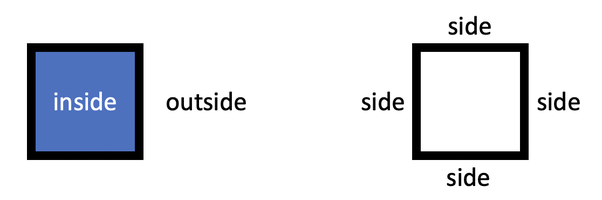
One day, the teacher drew a square on the board and asked us how many sides it had. I was confident in my answer and raised my hand along with the rest of the class. When called upon, I proudly declared, “It has 8 sides.”
I don’t remember the reaction of my classmates or the teacher, but I recall feeling proud of my reasoning. The teacher, however, corrected me and said that squares have 4 sides.
Unwilling to accept her answer, I approached the whiteboard and drew 8 numbered red arrows pointing to the sides of the square, explaining that there were sides inside the square as well and that all shapes would have twice the number of sides we were taught. I was convinced that I had discovered something amazing.
“Doubtless, the life of an Irregular is hard; but the interests of the Greater Number require that it shall be hard.”
Edwin Abbott Abbott, Flatland: A Romance of Many Dimensions
The teacher listened to my explanation but still maintained that the square had 4 sides, filled in or not. I wanted to continue the discussion, by pointing out that a line also had 4 sides, with a width on either end that couldn’t be ignored.
Although my argument was met with frustration from the teacher and probably my classmates, I was undeterred. I loved learning, but I also loved debating and breaking down the material to its “rules.” If the rules seemed inconsistent, I sought clarification.
This was my first encounter with the realization that rules are not always consistent and that there is always room for exceptions.
The lesson I learned extends beyond the classroom and into real life.
The rules of math, grammar, and life itself are not always absolute and there is always room for interpretation and exception.
Life has no rules. Except when it does.
 Oliver Conti Art